A simple shift that turns deal reviews into a transformational meeting.
Observation 🧐
Deals rarely fall apart because reps don’t work hard enough.
They fall apart because reps run through the motions and don’t have a chance to stop and think about the bigger picture.
There is one part of my operational process from my years leading sales teams in corporate that I think was misunderstood by Reps and misused by Leaders.
The Deal Review meeting. (AKA Deal Strategy, Big Bet, Deal Teardown).
Call it whatever you want. The purpose is the same.
A deal review is a strategic working session where a rep breaks down an active opportunity with their leader and cross-functional partners. The goal is simple: identify risks, uncover gaps, and strengthen the path to win.
This purpose doesn’t always come to fruition.
The Rep Experience
Reps feel exposed and interrogated.
They hold back information because they don’t want to look unprepared or unsure. They’re like the husband (or wife) in couples therapy who refuses to share anything real because the conversation feels too risky.
They don’t actually move the deal forward because they’re in defense mode, defending the current position.
The Leader Experience
Leaders treat the meeting like a status update. They spend the bulk of the time asking questions to get up to speed and understand why we are taking the current approach.
It becomes a backward looking conversation and does nothing to advance the deal or help the rep.
Instead of asking questions that unlock the rep, leaders ask questions so they’re prepared for their next forecast call.
Here’s my hot take.
Deal reviews should be one of the highest ROI moments in your operating rhythm. Instead, most are a waste of time.
The meeting could have been replaced by better notes in your CRM. No one thinks differently, no new insight uncovered and deals don’t actually move forward.
What Deal Reviews Should Be
Deal Reviews should be a working session.
A space with enough psychological safety to brainstorm, debate, and think creatively about how to move the deal forward.
You should be better positioned to win as a result. They force reps to pause the busyness of selling and actually think about the strategy.
Consider it deal therapy. The rep should walk away from the session feeling better about the problems at hand, not like they just got reamed out by their boss.
Deal reviews are also where pattern recognition gets built because the team gets to see what “great” looks like. The leader sees where the rep is struggling versus growing.
Ideally, the organization gets smarter deal by deal.
The Ideal Rep approach
Prepare to have a more meaningful discussion. Have a growth mindset, take advantage of this time dedicated to your deal (IE making you commission). Be on the offense (ask for what you need), not defense (protect your past decisions).
Send a 1 pager before the meeting to get the stakeholders up to speed before the session.
Apply the same strategic lens process for all the deals in your pipeline. Don’t wait for a deal review meeting to be scheduled for you. Bring together your cross functional partners and peers and rotate running through your deals. Build the muscle for yourself and it will change your year.
The Ideal Leader approach.
Prepare for the meeting to make it more valuable for everyone. Do research on the account, read the CRM notes, ask the rep to complete a template ahead of time and review it.
Be mindful of the types of questions you’re asking. Are you opening up thinking and new possibilities or are you critiquing what’s been done so far? Be Yoda (Star Wars) not Colombo (a detective).
“What” questions are more impactful than “Why” questions, which can put recipient on the defensive. Ask “What is blocking you? “ instead of “Why aren’t you doing X?…”
Ensure accountability for next steps. Create a process to follow up on deals so you maintain momentum.
Each deal we chase in our pipeline is like each basketball game in a season. You have to win each game to dominate the season.
Before each game, you develop a strategy to address the opponent.
During the game you adjust your strategy as needed.
After the game you watch the tape, see what you can do better before your next game.
The same goes for our deals. Strategic planning, real time adjustments and post mortems are critical.
When deal reviews shift from administrative updates to strategic working sessions, everything changes.
Deals move with intention, reps think more strategically, leaders coach with more clarity.
If you want a high performing team, start by upgrading your deal review meeting. Treat every one like the strategy session it’s meant to be.
Thought Starter 🤔
Deal Review Meeting Guidelines:
Create a Template
Share and develop it beforehand. Standardization allows everyone to know what to expect.
Your rep completes and sends the template before the meeting.
Everyone reviews it so the meeting doesn’t waste time on context-setting.
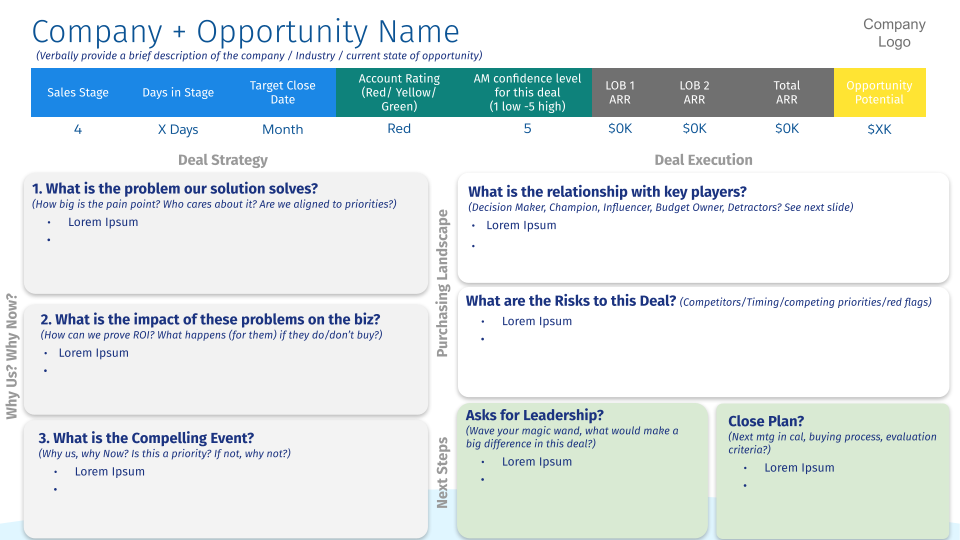
A good template forces deeper thinking not a CRM recap. If you want to see a sample template, check it out below.
Follow a clear agenda
5 minutes: Rep provides brief context (not a monologue) knowing everyone attending has already read the completed template.
20 minutes: Team discusses the deal. Ask questions that benefit the deal and rep, not the leader.
5 minutes: Align on next steps, owners, risks to track, and timelines. The point of the meeting is to take action on this deal, to move it, to advance forward.
Invite the right people.
Anyone impacting the deal should be there (Sales Partners, Sales Engineers, Customer Success, product specialists).
These sessions are learning goldmines, invite other reps to observe and chime in with their perspective of past success and suggestions.
Set the right tone.
This is NOT an interrogation. A root canal should not feel more pleasant than this meeting.
Leaders should be inspecting the deal, not the rep.
Psychological safety turns mediocre deal reviews into transformational ones.
Love 🥰
This is a sample Deal review meeting template. The intent is to have the rep leverage the process of completing it to really think about the strategy. It’s an opportunity to work ON the deal, not IN the deal.