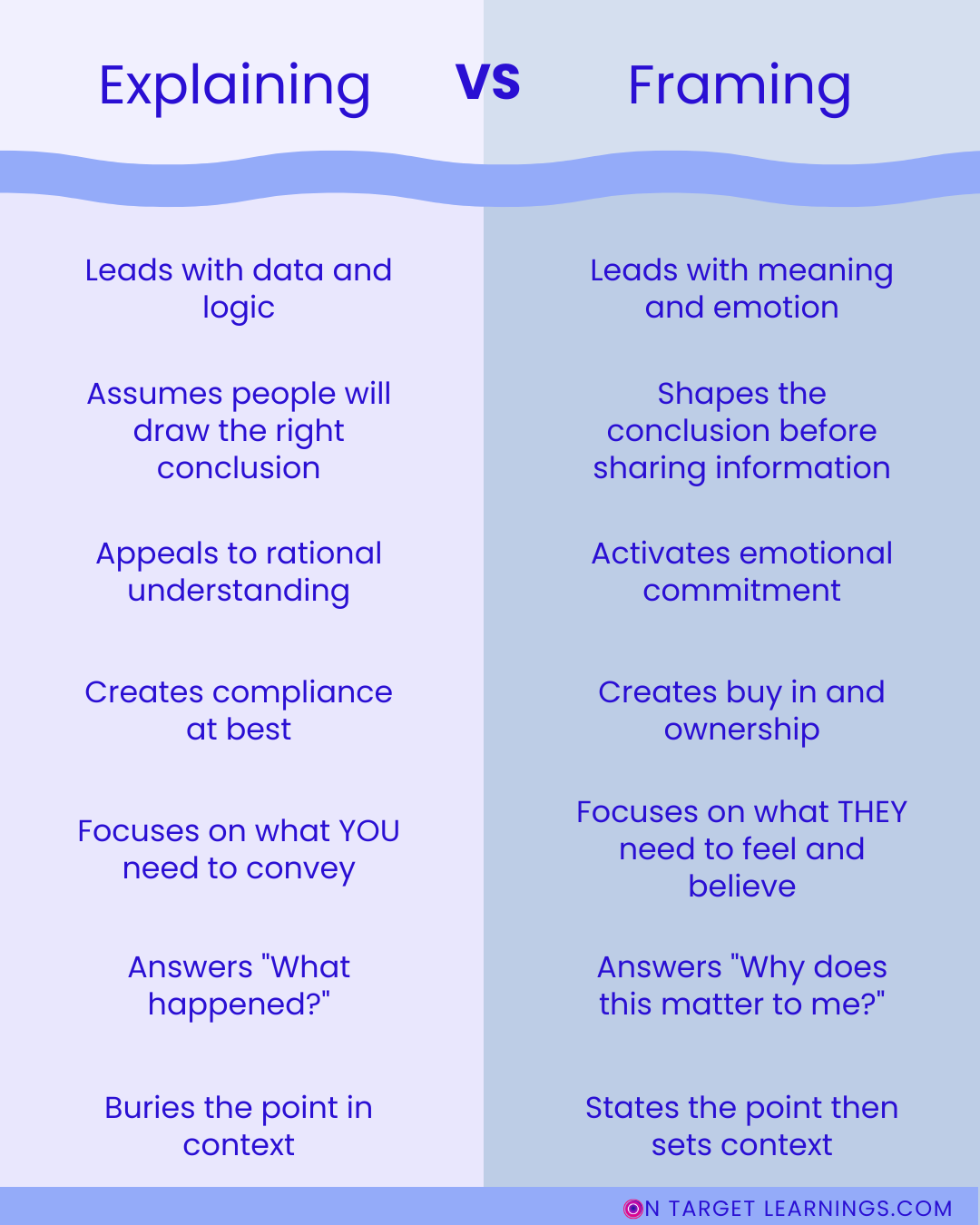
This communication mistake is costing you buy in
Observation 🧐
There’s one skill that many of us get wrong in communication. When we want to drive action, we bring a boatload of facts to the table in order to convince others of the path forward.
But this approach doesn’t inspire. Instead, our audience gets lost in the detail. If they take action it is because they feel they have to. Not because they want to.
The leaders who effectively mobilize teams towards a common goal actually understand that people need a "why" that resonates emotionally, not just intellectually. They need to see themselves in a story that matters.
Framing gives you that power because it transforms compliance into commitment.
Framing is about constructing the lens through which people interpret information, not just delivering the information itself.
It's the difference between saying
"We need to improve our discovery calls"
and saying "Every discovery call is a chance to completely change someone's perspective"
Same goal, completely different mental model.
When you frame something, you're establishing context, meaning, and emotional resonance before the facts are presented. You're answering the question "Why does this matter to me?"
When humans process information, it passes through our filters of existing beliefs, emotions, and narratives. When you just explain something with data and logic, you're assuming people will arrive at the same conclusion you did. But they're running that information through their own filters, their own fears, their own priorities.
Framing works because it preemptively shapes those filters. It activates specific emotions, connects to existing values, and creates a narrative container that gives the data meaning.
The Framing Framework
Before you deliver your message, ask yourself
"How do I want them to think about this?" (Framing)
Not
"What do I need to tell them?" (Explaining)
When you’re explaining, you start with data, timelines, or processes.
When you’re framing, you start with a clear statement about what this means and why it matters.
The difference isn't about removing information, it's about what you lead with and what you use to support your point.
Step 1: Identify What You Want Them to FEEL
Before you think about what to say, ask yourself:
What emotion do I want to activate? (Possibility? Urgency? Pride? Determination?)
How do I want them to feel in this moment?
What energy state will drive the behavior I need?
Step 2: Connect to What THEY Care About
Your message isn't about you or the company - it's about them:
What do they value? (Winning? Autonomy? Recognition? Growth? Fairness?)
What are they worried about right now?
What would make them lean in rather than tune out?
Step 3: Create the Story Container
Give them a narrative to step into:
Where are we in the journey? (Starting something new? In the middle of a fight? About to break through?)
What role do they play? (Heroes? Problem solvers? Pioneers?)
What's at stake that matters to them personally?
Step 4: Lead With the Frame
State your frame clearly in the first 10 seconds:
One compelling sentence that establishes the lens
Make it vivid, not abstract
Anchor the emotion before introducing any facts
Step 5: Let Data Support, Not Lead
Now you can bring in information:
Facts should reinforce the frame, not create it
Keep it minimal, just enough to validate the story
If the data contradicts your frame, you chose the wrong frame
Some Examples
When discussing a tough quarter, instead of walking through what went wrong, frame it as "We learned what doesn't work, and now we know exactly where to focus."
Reframe failure as education.
When rolling out a new process, instead of explaining all the steps and rationale, frame it as "Here's how we're going to make your job easier and help you win more."
Reframe bureaucracy as empowerment.
When addressing underperformance, instead of jumping into metrics, frame the conversation as "Let's figure out what's standing between you and the success you want."
Reframe criticism as partnership.
Framing creates clarity by giving people a way to make sense of everything else.
Master this, and you'll find your team doesn't just understand what you're saying, they're energized to act on it.