
Make deliberate practice your team’s superpower
Observation 🧐
I’m guilty of advising my team to just “put in the reps” in order to get better.
What I realize now, is that advice is incomplete. It’s not just the act of doing the thing, rather the act of deliberately trying to improve at doing the thing.
There’s a big difference.
Most salespeople believe they’re improving because they’re doing the work.
They run calls, negotiate deals, and present to customers daily. But that’s not the same as practicing.
Repetition is how you build experience.
Deliberate practice is how you improve.
If a rep runs 10 discovery calls a week, that’s experience.
But if that rep sets a goal for those calls (IE - use silence and pauses to communicate with more impact) and reviews their recordings, that’s practice.
It’s not about doing something over and over. It’s about doing it with purpose, feedback, and focus.
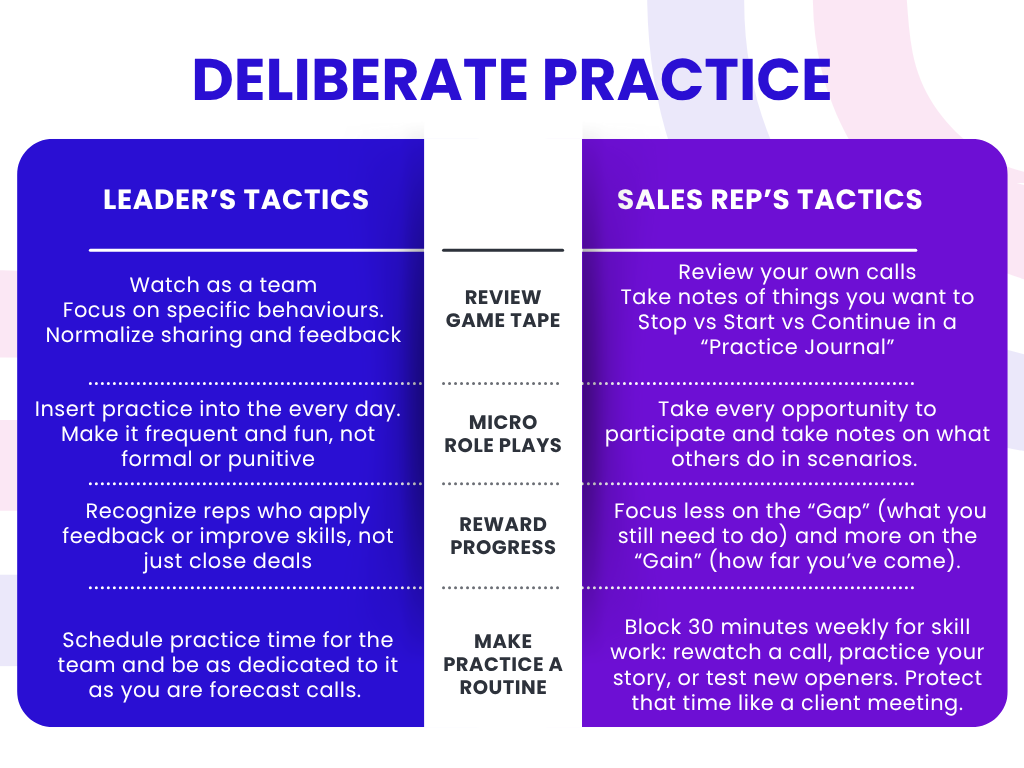
One of the easiest ways you can uplevel your team is to prioritize deliberate practice.
Deliberate practice has three parts:
A clear goal
Constructive feedback
Repetition and reflection
1. A clear goal
You can’t improve everything at once, so encourage your AEs to pick one skill.
This is the “one thing” you’ll focus on improving deliberately and make sure it’s measurable, not vague.
Examples:
Instead of “get better at discovery,” focus on “ask three follow-up questions before sharing a solution.”
Instead of “improve executive presence,” focus on “Use fewer words when communicating.”
Instead of “be more strategic,” focus on “connect customer challenges to measurable business outcomes.”
When you isolate one behavior, you make improvement visible and success becomes measurable.
2. Offer Immediate feedback
Practice without feedback will limit progress. AEs need a mirror to know what’s working and what’s not.
Feedback can come from:
A coach or leader: Ask them to listen for one behavior (“Did I dig deep enough in discovery?”).
A peer: Trade call recordings and review one skill each week.
A recording: Self-assess using a checklist (“Did I summarize before pitching?”).
The faster the feedback, the faster the learning.
That’s why elite performers don’t wait until the next quarterly review, they seek feedback in the moment.
3. Repetition and reflection
You can’t get better at something you only try once. Repetition builds muscle memory; reflection turns it into mastery. We need to reflect on our progress and adjust accordingly.
Self reflection ideas:
After each call, jot down one thing you improved and one thing you’ll try differently next time.
If you’re practicing objection handling, run three quick-fire rounds with a peer and then debrief what worked.
Record yourself delivering your product pitch three times. Compare versions one and three. What changed?
Reflection is where growth compounds.
It’s what turns “I did it” into “I understand why it worked.”
Thought Starter 🤔
Love 🥰
So much love for the Toronto Blue Jays. They were last in the league last year and now battling it out in the World Series. An incredible story of deliberate practice, perseverance and belief in oneself. Go Jays!